
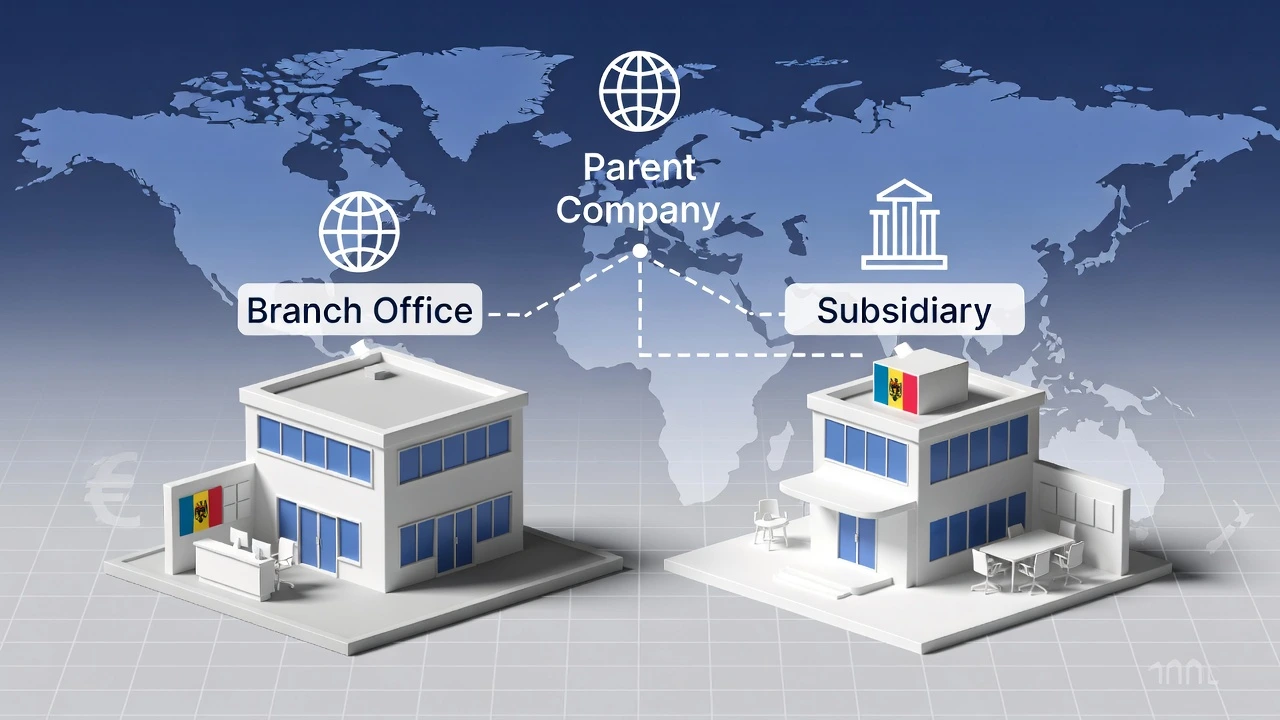
Subsidiary vs Branch in Moldova: Legal Comparison for Foreign Companies
Introduction
Foreign companies considering expansion into the Republic of Moldova often need to decide between opening a branch office or establishing a subsidiary company. Each structure has distinct legal, tax, and operational implications that affect long‑term business strategy.
This guide explains the differences between a subsidiary and a branch in Moldova, registration requirements, tax implications, liabilities, and recommended use cases for foreign investors.
What Is a Branch Office in Moldova?
The branch of a foreign company is not a legal entity. The branch of a foreign company operates according to its own regulations, approved by the body that decided to establish the branch. The foreign legal entity is liable for the obligations arising from the activities of the branch in the Republic of Moldova.
If a foreign company decides to operate in Moldova through a branch, the structure must first be registered in the State Register of Legal Entities.

What Is a Subsidiary Company in Moldova?
A subsidiary is a separate legal entity incorporated in Moldova under local law. It is usually formed as a Limited Liability Company (LLC), which can be wholly owned or majority‑owned by a foreign parent.
Unlike a branch, a subsidiary has its own legal identity, assets, and liabilities distinct from the foreign parent company.
If you are considering entering the Moldovan market as a local business with independent operations, see our guide on company registration in Moldova for a step‑by‑step process.
Key Differences: Subsidiary vs Branch in Moldova
| Feature | Branch | Subsidiary |
|---|---|---|
| Legal status | No separate legal personality | Separate legal entity |
| Liability | Parent company fully liable | Liability limited to subsidiary’s assets |
| Tax registration | Registered as extension of parent | Separate tax registration as local company |
| Local operations | Directly on behalf of parent company | Independent business activities |
| Closure | Simpler administrative closure | Dissolution under company law |
Advantages and Disadvantages
Branch Advantages
- Easier and faster registration than subsidiary
- Direct extension of parent company
- Lower initial setup costs
Branch Disadvantages
- Parent company is fully liable
- Limited flexibility in local operations
Subsidiary Advantages
- Separate legal identity protects parent company
- Better suited for long‑term local operations
- Can hire employees, open accounts, and obtain permits independently
Subsidiary Disadvantages
- More complex incorporation process
- Potentially higher administrative cost and compliance requirements
When to Choose a Branch vs Subsidiary
Choose a branch if your foreign company plans to:
- Test the Moldovan market before committing to full incorporation
- Conduct limited activities on behalf of the parent company
- Execute specific contracts tied to the parent company
Choose a subsidiary if your company plans to:
- Set up a long‑term presence in Moldova
- Operate independently with local contracts and employees
- Build brand recognition as a local entity
If your company plans to build a long-term presence in the Moldovan market, establishing a local entity may be the most practical solution.
Practical Steps to Establish a Branch or Subsidiary
- Decide on the legal structure based on business strategy
- Prepare corporate documents and translations
- Submit registration application with the Public Services Agency
- Obtain local tax registration and accounting setup
- Fulfill licensing requirements if applicable
- Open local bank accounts
FAQ – Branch vs Subsidiary in Moldova
What is the main difference between a branch and a subsidiary in Moldova?
A branch is an extension of the parent company without separate legal personality, while a subsidiary is a separate legal entity incorporated under Moldovan law.
Can a foreign company open both a branch and a subsidiary?
Yes, depending on business goals, a foreign company can maintain both structures for different commercial purposes.
Which structure has lower setup costs?
Generally, establishing a branch is faster and less costly initially, while a subsidiary may incur higher administrative expenses due to full company formation requirements.
Can a subsidiary hire employees directly?
Yes, a subsidiary as a separate legal entity can hire employees, open bank accounts, and enter contracts independently.
Explore Company Registration in Moldova
If you need professional assistance, visit our company formation services in Moldova
.
ASK A QUESTION or ORDER A SERVICE
click the icon to call us


Written by : Law Office Viorel Furtuna